Essay V
How Emotional Intelligence was Overridden by the Civilized World
Introducing the Brain Model
By Chet Shupe
(To download document, click on the download button at the end of this document. To download the audio, click on the three dots just below.)
The Species as the True Organism
For centuries, we have built our theories of mind, morality, and society on the idea that the individual is the fundamental unit of life. We have prioritized personal property, individual rights, and justice systems designed to protect the self from others.
But what if the real organism is not the individual, but the species?
If that were true, we would find meaning not in competing against each other to serve self, but in cooperating to serve the species that gave us life. I don’t intend to prove this. But the brain model I’ve developed is based on the belief that the species is the true organism. I arrived at this view because, when I tried to diagram how the brain is organized, nothing else made sense.
When life is observed from the perspective that the species is the real organism, many contradictions dissolve. The soldier’s sacrifice, the hero’s selflessness, the mother’s devotion—these are not irrational acts. They reveal the inborn sensibilities of a system tuned to serve life. Serving the species isn’t about righteousness. It’s simply that, if our species is to continue gifting people with the experience of life, its members must act as agents of the species—placing its needs above their own, just as a government cannot exist unless its citizens prioritize the state’s needs over their own.
Agents of Life vs. Agents of the State
But we have innocently subordinated our lives to legal systems designed to sanctify the individual. In doing so, we moderns have shifted from being agents of life to agents of the state. We are compelled to prioritize the needs of the state over those of our species. This leaves us in an unnatural state of suffering.
Our suffering is not the result of moral failure. It is emotional intelligence trying to warn us that if we continue to ignore the needs of our species, eventually it will cease to exist. Being true to our feelings, rather than to the directives of the state, is not about passing a moral test. It is about human survival.
The Spiritual Cost of Survival
Trying to explain human behavior while believing that each person’s life is sacred is like trying to explain the movement of the planets while believing Earth is at the center of the solar system. Nothing makes sense. Our current way of life, built on the sanctity of the individual, is only possible because governments provide laws to guide us—not because it satisfies the soul. If it did, our souls would guide us. No prescriptions for behavior would be needed. We accept this way of life, even though it doesn’t bring contentment, because we want to survive. But the cost of survival is spiritual repression, which diminishes the value of the very life we’re trying to save—our own.
A Way Beyond Shame
I hope to show that there is another way—a way of life where we satisfy the needs of our souls by helping each other serve life, rather than living in shame for how we feel. Shame that arises because our culture has taught us, by word and deed, that if we can’t manage on our own, we’re not good enough.
But for that to happen, we must see the life of our species as sacred—not our own. Given the indoctrination we’ve endured, and the comfort we’ve learned to take in it, this shift is difficult.
Though I promise nothing, I believe that if we can let go of the idea that our individual lives are sacred, we may, in time, be relieved of a heavy burden: civilized man’s unnatural fear of death. Our heads don’t know this, but our hearts do: Only when we are free to die are we free to truly live. Regaining the freedom to truly live is our destination. But we will have to let it happen. We will never get there if we make it our goal.
Rules as Barriers to the Human Spirit
First, we must understand why setting goals suppresses the wisdom of our souls. Intellectual intelligence has no intuitive grasp of this. But emotional intelligence sees every rule, every long-term objective, as a neon sign on the front door that says: The Human Spirit Is Not Trusted Here.
The spirit cannot tolerate rules—not because of the spiritual insult they imply, but because where rules exist, the spirit cannot fulfill its natural role: managing the behavior of thirty or forty people so they find contentment in supporting one another on behalf of the species.
A single rule—who does specific chores, who can sleep with whom, when the lights are to go out at night—interferes with life’s process. And when a process of such incredible complexity is interfered with, things begin to go wrong for reasons no one understands. This prompts our rational minds to take satisfaction in pointing out who they have decided is to blame. And where does that leave us? Pretty much where we are now—lonely, disconnected, confused, and estranged.
I say all this to make one thing clear: If we are ever to complete the journey to the place where we can truly live, the last leg of the journey will be entirely under the guidance of the human spirit.
One last thing before we move on to the brain model. How can we expect people to turn away from the glory that civilization promises, and instead dedicate their lives to the well-being of a community of sisters and brothers who promise nothing—nothing, that is, that exists in the objective domain? I’ve given this some thought. Here’s my answer:
If we ever reach the point where we value civilization as much as Jesus did—which, as he made clear in his Sermon on the Mount, is roughly as meaningful as a pile of rocks—then those sisters and brothers might resemble angels waving us home, standing in the middle of the wide-open parley gates.
Well, that might be a bit much. But you get the idea.
The Brain as a Control System
At the center of this essay is a control diagram—a model of the brain that sees consciousness not as a hierarchy of intellect but as a dynamic system of inputs, feedback, and responses. The structure is simple: sensory signals arrive, emotional intelligence interprets, and the conscious mind acts on that interpretation. When circumstances are natural—there are no legal contracts to honor—emotional intelligence knows the way. Contentment appears as evolution’s reward for supporting life. And life continues—not perfectly, but well enough to thrive. However, with the rise of civilization—when people decided that well enough wasn’t good enough—the concept of good and evil was introduced. This was a notion that emotional intelligence had never encountered. That knowledge started to bias its judgments, leading the conscious mind to make decisions that no longer aligned with life’s needs. Discontent emerges as evolution’s response—a signal that we, as living beings, are no longer serving life.
And life continues—at least so far it has. But ever since gaining the knowledge of good and evil, the experience of being alive has never been the same. Rational authority now surpasses intuitive understanding. Legal obligations take priority over spiritual ones.
Are we alive—or is this a performance?
And if it is a performance, who is it for?
Where is the applause?
This essay reveals how the knowledge of good and evil transformed life from a soul-guided experience into an act—a revelation necessary for the relationships that make life a self-sustaining process, to reemerge.
So, what exactly is emotional intelligence? And how can the same brains that built rocket ships and mapped galaxies be so vulnerable to self-deception—so eager to believe that the unknowable future is ours to control? What is a spiritual home?
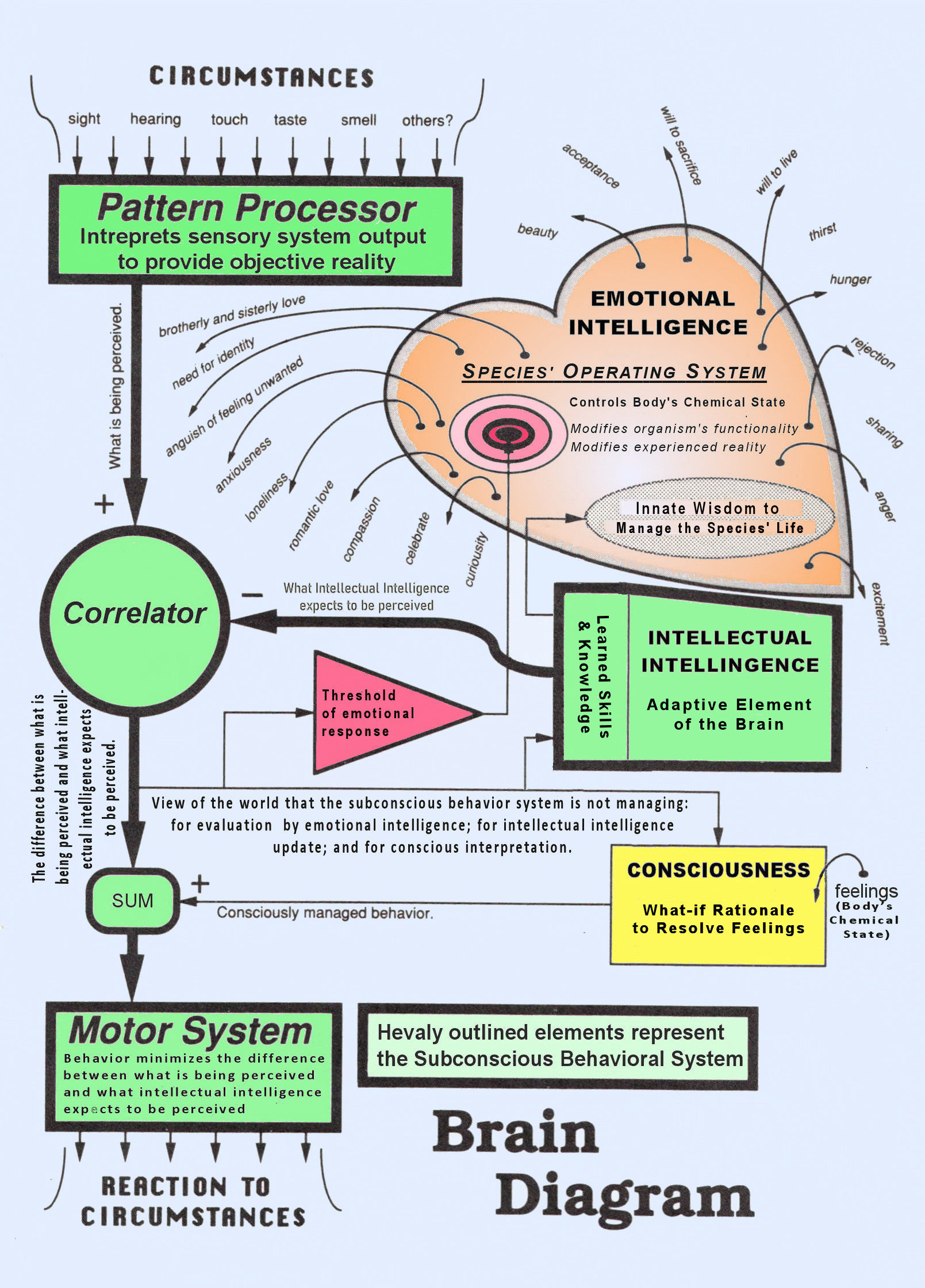
To answer these questions, I’ve created a “Brain Model” diagram. It offers a visual reference for studying human behavior—not biologically, but functionally.
The Honor of Serving Life
When studying anything—especially something as intricate as the brain—the first step is to identify its purpose. I’ve concluded that the brain exists to produce behavior that optimizes the likelihood that the species will flourish. Nothing more, nothing less. That might seem like a letdown for those who believe our destiny is to inhabit the far reaches of the universe. But if you ever have reason to think that’s a bit of overreach, then taking care of life on Earth doesn’t seem so bad. In fact, for our brains to be commissioned by evolution to handle such a complex job of managing the life of a species is a great honor. What more could our brains ask for? To me, managing a species’ survival is so complex that if evolution had assigned the brain additional tasks, it’s unlikely any species would survive. That’s the foundation upon which this model is built.
As you read the description of the diagram, keep in mind: you don’t have to understand every detail. Feel free to skip the finer points if you prefer. What’s important is seeing the big picture—understanding why modern humans depend on cold, hard facts for guidance, instead of the warmth of our living hearts. This mistake is not only affecting our wellbeing but also the wellbeing of life on Earth.
The Intimacy We Were Made For
This is not to suggest that we are here to take care of the world or the countless other lifeforms that make it their home. The web of life can take care of itself. We are here to participate in the web of life by caring for one another through the intimacy inherent in interdependent relationships. We are social primates by heritage. Without intimacy, we are not whole. Without intimacy, we don’t truly know ourselves—that is, what Nature made us. Without intimacy, we are never at peace with ourselves. And without intimacy, all the emotional faculties evolution gifted us to support each other in our service to life—most significantly our ability to love and be loved—are wasted.
The Lament of the Loveless
As I struggle my way through this loveless existence, I realize I am among the fortunate few. There are countless others whose struggles are far greater than mine. Here is my lament: it’s not that we humans don’t know what we want. Jesus told us what we want two thousand years ago. People were—and still are—so drawn to his message that he became one of the most highly regarded spiritual leaders of all time.
What we want is to love one another, take care of one another, serve one another, forgive one another, and carry one another’s burdens—just as he said. Deep down, we know that giving our lives in service to others is our only path to contentment. Yet, the people of his day—just as today—did not know how to realize what they wanted.
So instead of considering the possibility that something has gone wrong, we blame ourselves and each other for not being able to have what we want. And that only deepens the suffering. That’s why I shed tears from time to time. I believe something has gone seriously wrong, but we had no way to realize what it was or when it happened. It’s when I think about how different things could have been, if only… That’s when I grieve.
The Illusion of Good and Evil
Through a merging of my background in systems control theory and a few other chance events, about forty years ago I stumbled upon what I believe happened, and it caused pain. At the time, I thought I was making the world better by developing weapons to protect good institutions from evil ones. But once I realized what had gone wrong—at least as I see things—I no longer believed in the concept of good and evil. If I weren’t here to do good, then what was my purpose? That’s what hurt. It hurt so deeply that there were moments I couldn’t see the ground—not because it wasn’t there, but because, emotionally, my life had nothing to stand on.
But one of the graces of Nature is that the mind can recover from almost any shock—except, perhaps, when a mother loses a child. In my experience with women who have lost a child, I don’t believe they ever truly recover from that.
Once I got past the shock of it all, I’ve spent my life trying to explain to others what I think I see. People might wonder, Why do this, if it causes suffering? A fair question.
Toward Spiritual Trust
First, I believe that once people see through an illusion—in this case, the promise that by doing good, and not doing evil, will lead to an ideal existence—they will never regret it, even if it costs them their lives.
And second, only when people realize that they are not culpable, nor is any other human on earth, for our inability to have what we all want—to love and be loved—will we have reason to stop blaming one another. This realization is the precursor to spiritual trust—the precursor to loving one another, which is what we all seek.
The Brain Diagram: A Model of Trust
The diagram I’m about to describe has been key to my effort to connect the words that might help others see what I believe I see—or, as I prefer to think of it, to help people regain their trust in the wisdom of human nature.
The Six Elements of the Brain Diagram
Emotional Intelligence reveals—through feelings—an innate wisdom that has been accumulating genetically since the first stirrings of life on Earth. By abiding by the “Law of Life”—do what feels right and avoid doing what feels wrong—countless species live in sufficient harmony for life to flourish on this planet.
Intellectual intelligence is the brain’s adaptive element. It learns where life’s necessities—such as food, water, and shelter—can be found and acquires the skills needed to use them.
Consciousness is our window on the world, which opens in two dimensions: subjective reality and objective reality. Subjective reality reveals life’s needs through feelings. Objective reality reveals the physical domain in which those needs must be satisfied.
The pattern processor processes the millions of signals arriving from the sensory system to provide the mind with an objective awareness of its circumstances.
The correlator detects differences between the signal arriving from the sensory system and the one arriving from intellectual intelligence, instigating corrective action.
The motor system is the brain’s output.
Subconscious Behavior and Adaptive Learning
To understand how the elements of the diagram interact, we begin with the “subconscious behavioral system.” This system includes the pattern processor, intellectual intelligence, correlator, and motor system—each depicted with heavy lines in the diagram. Consider the experience of driving a car: it’s not uncommon to realize, after several minutes, that we have no conscious recollection of what just occurred. This doesn’t mean the brain was inactive. Think back to how difficult driving felt the first time you sat behind the wheel. That same complexity is still present, but now, through repetition and learning, intellectual intelligence—the brain’s adaptive element—has acquired the necessary skills to manage the task automatically.
Through experience, intellectual intelligence learns where the road should appear in relation to the car. When the vehicle drifts to the right or left, the output of the pattern processor no longer matches the expectations held by intellectual intelligence. This mismatch generates a signal at the correlator output, which directs the motor system to adjust the steering wheel accordingly. The goal is to restore alignment between the sensory input and the learned pattern—indicating that the vehicle is correctly positioned. Once this correlation is achieved, the motor system input returns to zero, signaling that no further action is required. Routine behaviors—such as driving a car or playing a musical instrument—are managed in this way, subconsciously, without the involvement of emotional intelligence or conscious awareness.
When Emotion and Consciousness Take Over
These two elements—emotional intelligence and consciousness—come into play when an unexpected event occurs. Imagine another vehicle running a red light and placing you in immediate danger. The pattern processor registers the event, but intellectual intelligence, having little or no prior experience with this specific scenario, does not. As a result, the correlator’s output contains all the relevant information about the impending accident. This signal is distributed to multiple destinations. First, it crosses the “threshold of emotional response,” alerting emotional intelligence that something unusual has occurred. It is also sent to intellectual intelligence, since any information appearing at the correlator output must eventually be learned in order for the brain to manage similar situations subconsciously in the future. Although avoiding a car that runs a red light is not routine, the fact that this information is applied to intellectual intelligence ensures that the event will be remembered. This explains why people often vividly recall the details surrounding moments of unexpected news—such as the assassination of a religious or political leader.
The correlator output, which contains information about the impending accident, is also sent to emotional intelligence, after being processed by the knowledge that intellectual intelligence has accumulated from personal experience, as indicated in the diagram. The significance of the fact that this signal is preprocessed by what intellectual intelligence has learned from experience is discussed later. Emotional intelligence reacts to the correlator output by changing the body’s chemical state. This rewires the neurological system, preparing the mind-body to respond optimally to the situation. Finally, the correlator output is directed to consciousness, one of the two main inputs to the conscious mind, providing it with an objective view of the emergency. The conscious mind’s other input is fear, which arises from the body’s highly aroused chemical state induced by emotional intelligence. The conscious mind reacts by maneuvering the vehicle to avoid a collision, thereby restoring the body to its unaroused chemical state, but not instantly. The chemicals linger, and so does the fear.
Feelings arise from the conscious mind’s capacity to interpret the body’s chemical state. Each distinct state corresponds to a particular feeling. Emotional intelligence rewards consciousness with satisfaction when it guides actions that restore the body to its normal, unaroused chemical state—such as eating to relieve hunger or sex to resolve feelings of romantic love. Once the feeling is resolved, the conscious mind experiences contentment, its true objective in both humans and animals. In the natural world, success is measured by contentment. In the civilized world, success is measured by wealth. Yet wealth does not fulfill life’s essential needs, and so the civilized are deprived of lasting contentment.
Feelings as Evolution’s Compass
Emotional intelligence is multi-minded. It attends to all the species’ needs simultaneously. When circumstances require action, such as the individual needs to put on a jacket, or needs to get the attention of a special other, emotional intelligence issues a feeling, such as a chill, or romance, to inspire the needed behavior. And both behaviors serve the species. If the emotional mind could not detect temperature or produce a feeling, such as a chill, to inform us that we needed cover, we could freeze to death and never know why we are dying. People who have frozen to death are of little use to our species. And when emotional intelligence tags a couple with feelings of romance, it tells them that our species wants a new member, and it wants the conception to occur now. It also makes clear which individuals it wants involved in the conception. As for why those specific individuals and why now, that is not for us to know. We can only speculate.
However, because of the brilliance in how evolution arranged things, we never need to know the answer to questions such as, ‘Why do I need to drink water now?’ or ‘Why do I need to make love to that man now?’ The behavior required to sustain the life of a species is justified by feelings, never by knowledge.
There is one thing, however, that we can count on: If we stay true to our feelings in response to the situation at hand, we will find contentment. That is how emotional intelligence rewards us for serving life. But if we deny those feelings—whether to honor a promise made long ago or to protect a future we are imagining—we will suffer. Feelings of romantic love, like hunger or thirst, become unbearable when unmet. And just like an animal that suffers when it cannot find water, we suffer when our feelings go unfulfilled—even if we have a perfect excuse. That’s the point: Though our species is taking damage, ultimately its survival depends on our feelings being satisfied in real time. So, when we ignore how we feel—regardless of the reason—we pay a price. Even the idea that we’re “keeping a promise” doesn’t free us from emotional intelligence’s punishment for not being true to life.
We need to think about that the next time we consider making a long-term promise. That’s a lot to ask of people living in a culture that functions only because we make and keep promises. But if anything is ever going to change that relieves us of our unnatural state of pain, as some point we need to ask: What are those promises costing us in terms of suffering?
Our long-term promises are, in effect, depriving us of our spiritual lives. And perhaps even more troubling. How can our spirits prove themselves trustworthy when the promise-makers are outlawing them—the very people (all of us) who, by making promises, reveal that we don’t trust our spirits? By insisting on promises, we are silencing the only voice that, as I see it, can take us to our spiritual homes.
Stage Fright and the Interference of Consciousness
Regarding further considerations on how the elements of the brain diagram interact, I leave that to the reader, if so inspired. As an example, individuals who have practiced a performance, to near perfection, are often unable to perform it as well, on stage. This occurs because emotional intelligence is so concerned about doing well, that it “emotes” feelings/chemicals of anxiety which we typically refer to as stage fright. This inspires the conscious mind to contribute, by trying to improve on the rehearsed performance, an effort that is usually counterproductive.
Evolution’s Masterpiece
The human spirit—born of emotional intelligence—is evolution’s masterpiece, designed to guide us into serving the life of our species, through interdependent living. It rewards us with contentment when we place the needs of our sisters and brothers above our own and burdens us with guilt when we don’t. Yet, civilization has replaced this inner guidance with the pursuit of personal ambitions, deeming interdependence a threat to civil order, and legally binding us to promises that imprison the soul. Spiritual freedom—and the care of our species—require fidelity to present feelings, rather than past commitments. But civilization demands the opposite, forcing us to repress the very feelings that would lead us to serve life. In that repression, we suffer, then seek comfort in the illusion of a promised land that will appear if everyone keeps their promises. The tragedy is that the promised land does not exist—and so we suffer without ever recognizing the cause. By discussing the brain diagram, I am attempting to reveal why we suffer, and to show how simple life is meant to be and will be again if we trust it.
Consciousness and the Prioritization of Needs
To understand why we exist in an unnatural state of suffering, we begin by referring to the brain diagram—specifically, the function of the conscious and subconscious minds. The subconscious mind, which reveals its awareness through feelings, is multi-minded. It attends to all the organism’s needs. On the other hand, consciousness is single-minded. When multiple feelings surface at one time, indicating there is more than one need to be satisfied, the conscious mind attends to the strongest feeling, thus, to the greatest need first. For example, if an animal is grazing in open terrain as a blizzard approaches, the drive for shelter intensifies while hunger wanes. Once the desire for shelter outweighs the desire to satisfy hunger, the conscious mind starts evaluating its options, by “what-iffing” its circumstances—what if I go here, what if I go there—to determine how best to satisfy its need.
In the end, understanding the finer details of the brain diagram are secondary. What matters is understanding how reality is experienced by the conscious mind—as the interplay of two domains. The first is objective reality, supplied by the senses and by what intellectual intelligence has learned regarding the features of the habitat. The second domain is subjective reality, supplied by emotional intelligence, which reveals the species’ needs through feelings. Together, they shape a living organism’s understanding of the world and its motivation to act within it.
Regarding survival, emotional intelligence provides the will to live—the capacity to value one’s own existence. Intellectual intelligence enables recognition of threats that endanger one’s existence. Both are essential to survival: without the ability to value one’s own existence, there would be no reason to avoid danger; without objective reality, there would be no way to detect danger.
In short, for consciousness to exist, both objective and subjective realities are required. Subjective reality not only imbues consciousness with the will to live, but it also tells consciousness what to do: Do what you feel is the right thing to do, and, conversely, don’t do what you feel is wrong. Otherwise, you won’t be able to live with yourself.
Built-In Rewards and Punishments
There is a reason why spiritually free people do not reward one another with trophies or punish each other with imprisonment: All the rewards and punishments required to maintain the social order that sustains our species’ life are built in. They occur instantly and are thus unavoidable—contentment for doing what feels right and guilt for doing what feels wrong.
Guilt, I believe, can be as severe a punishment for a spiritually free person as prison is for a civilized one. If the prisoner is fortunate, his sentence has a termination date. Guilt, on the other hand, can burden someone for life. Except in cases of behavioral disfigurements, I suspect that spiritually free cultures—in which no legal obligations must be satisfied, and no long-term promises must be kept—rarely experience behavioral problems. Who, in their right mind, would do anything that might burden them with a lifetime of guilt?
I learned that lesson early in life. I was three or four when my brother and I received identical Christmas presents—little toy rabbits, which, when you pushed the tail down, went scooting across the floor. I broke mine by improperly rewinding it. So, in secret, I broke my brother’s, by doing the same thing. I remember that, all these years later, as clearly as if it happened yesterday. I still ask myself: What on Earth possessed me to do something like that? I don’t dwell on it. I didn’t harm or kill anyone. My brother doesn’t even remember the incident.
The Soul’s Restraints
But the point is clear: even when external restrictions are absent, the soul has its own. And I suspect those soul-felt restraints are significantly more powerful than any imposed by institutions. People don’t go around wantonly killing people because we know, by instinct, that we would suffer from guilt if we did.
If someone becomes so emotionally provoked that the arousal overrides their inner restraints, I doubt legal ones will stop them either. That’s a truth that institutions quietly fear: that the real architecture of morality lies within, and it does not answer to law. After making the above remarks in discussion groups, I’ve sometimes suggested that if all laws against murder were struck from the books, the murder rate would hardly change. And—much to my surprise—nearly everyone always seems to agree.
Destiny and Control
If inborn emotional restraints maintain social order, why have humans replaced them with externally imposed systems of punishment? Once humans acquired the spoken word and, with it, the ability to imagine future circumstances, we became obsessed with controlling our destinies. Internal restraints exist to sustain life, not to control the future. Controlling the future requires artificial restraints, thus governmental intervention.
Two problems undermine mankind’s attempt to control the indefinite future. First, the future is inherently unknowable. No matter how elaborate our systems of governance are, or how strictly they control us, they cannot guarantee future outcomes. Second, external restraints apply equally to every individual in a mass culture. By treating subjects as blank slates, governmental interventions displace both internal restraints and internal rewards, leading to immediate spiritual repression, from which we emotionally suffer, and eventually social chaos, from which we materially suffer.
Emotional Intelligence and Species Survival
To explain the connection between mankind’s effort to control our destiny and our unnatural state of suffering, we again turn to the brain diagram. The input to the gray area, within emotional intelligence—which is labeled, “Innate Wisdom to manage the species’ life”—is pre-processed by the knowledge that intellectual intelligence has learned from personal experience (follow the arrows). This preprocessing is essential because, to satisfy feelings, such as hunger, thirst, or fear, the brain must know where food, water, and safety are located. For most of mankind’s evolution, the safest place to be was within a group whose members depended on one another to survive. Thus, every social primate’s awareness that groups provide the safest environment is not mere knowledge. Because it applies to all social primate cultures, it is also grounded in instinct. As a result, most of the feelings emanating from emotional intelligence in the brain diagram exist to reward people with contentment, for serving our species, within the context of interdependent relationships.
The Fossil Record of Belonging
Because emotional intelligence equates safety with interdependent living, there is no evidence in the fossil record that, before humans institutionally subjugated themselves, they ever survived by living alone or as mating couples. Since then, we have lived almost exclusively either alone or as couples, and have therefore sought safety in institutions and personal wealth. Our new way of life provides remarkable material advantages. But, because institutions will not tolerate interdependent living, we are without natural homes, where—by surviving interdependently—we would feel safe, whether we were or not. Consequently, we are burdened with loneliness, anxiety, and, with no sisters or brothers to take care of, a profound sense of meaninglessness. Yet, we remain blind to the cause of our suffering.
This blindness raises a question: With all the knowledge we have accumulated, and all the research facilities we possess, how can we remain so blind to why we are suffering, when, in view of the above observation, the answer seems obvious?
To further address the question of why we suffer, we again refer to the brain diagram. In a specific habitat, an individual learns, from experience, what must be done to survive. Because this awareness applies to the habitat, it is categorized, in the diagram, as knowledge. If the knowledge of what is required to survive aligns with an individual’s emotional intelligence, then, in the process of surviving, the individual will serve the needs of the species. For that service, the human spirit rewards the individual with a deep sense of purpose, contentment, and belonging. In this way, evolution makes the experience of being alive a win-win-win proposition: First, we survive. By doing so, we contribute to our species’ survival by serving others’ needs. And finally, emotional intelligence rewards us, for our service, with peace of mind.
Institutional Subjugation and Suffering
Contrast the spiritually free way of life, described above, with an institutionally subjugated one: Modern human relationships are not grounded in the desire to “be there,” for one another, to fulfill each other’s real and present needs. Modern human relationships are based on legally imposed promises that we struggle to keep, in the belief that, if everyone complies, we will reach the promised land. Instead of experiencing the sense of well-being that comes from mutual trust, we live in a state of shame, interpreting our suffering as evidence of unworthiness before God. Yet, even in suffering, wisdom emerges if we learn to interpret it. Keep in mind what Jesus said: “Blessed are those who are poor in spirit, for theirs is the kingdom of heaven.” In other words, those whose souls recognize that something is tragically wrong will be the ones who enlighten the way to our real homes as we begin awakening to the needs of each other’s souls.
Feelings as the Basis of Reality
This explains why we suffer, but not why our brains are blind to its cause. From the conscious mind’s perspective, feelings are the basis for all values. We think of objective and subjective reality as separate entities, which they are. But, without feelings to infuse the objective world with values, the objective world would not exist—not for us. To illustrate: Suppose we had no emotional intelligence, thus we could not experience any feeling at all. If a tiger emerged from the undergrowth, a few yards away, unable to experience the phenomenon of fear, we could place no negative value on the animal’s presence. And, without the will to live or the ability to experience pleasure of any kind, we could place no positive value on our own existence. We would not react to the tiger’s appearance—not because we were unable, but because, without feelings to satisfy, we would have no reason to react. We view thinking and feeling as separate processes. They are quite different, of course, but we fail to realize that, without feelings that need satisfying, there would be nothing to think about. In other words, from an objective point of view, an individual might be a perfect living specimen. But if the individual were without emotional intelligence, there would be no one home.
To grasp the depth of mankind’s problem, consider the fact that, when our kind began social contracting, the centralized systems of governance on which we have since depended, for survival, have been treating us, largely, as if there is no one home—except, of course, for our fear of what might happen to us, both socially and materially, if we did not comply with institutionally ordained law. To resolve that fear, we have no choice other than to repress most of our other feelings. Consequently, we not only suffer but, for the most part, exist in a state of mindlessness.
If I had developed the diagram to explain the functioning of the civilized mind, the arrow indicating our will to live would dominate the scene. The other arrows—which indicate the feelings through which our emotional intelligence rewards us for serving life would be diminished, most of them to the point of nonexistence. Being forced to seek safety in legally imposed promises and personal wealth, our spirits are not free to take care of life, and we suffer unnaturally.
I say unnaturally because life is not ideal. There is suffering to bear even when spiritually free. The difference is that, when suffering belongs to a larger living order, it has meaning. It becomes bearable.
Confirmation Bias and the Promised Land
Having established how significant feelings are to the reality that an animate being experiences, we can now address the reason why the human brain is blind to the cause of our suffering. When we make, and accept, legally imposed promises, in the belief that compliance will lead to the promised land, our minds place positive value on—thus, perceive as real—something that does not exist: The promised land. To comply with our promises, in pursuit of the illusion that the promised land is real, we must deny the feelings that would otherwise lead us to participate in life’s process. Denied the freedom to enjoy life’s process, our minds cannot place value on it; thus, for us, it doesn’t exist. The idea that we suffer because we are failing to serve life’s process, which doesn’t exist—not in our minds—is incomprehensible, so much so that our minds will not register it. When our subconscious minds fail to register an idea, then our conscious minds are denied the opportunity to consider it. That is why we are blind to why we suffer.
Historic Parallel
The history of civil cultures shows how confirmation bias—the brain’s inability to register ideas that contradict what it already believes—blinds societies to simple observations. Galileo’s demonstration that the sun, not the earth, lies at the center of the solar system offered a solution far simpler and more accurate than the elaborate models that preceded it. Yet, his discovery was fiercely resisted, not because the evidence was weak, but because it threatened the authority of scripture and the legal systems built upon it. Fear of civil disorder kept intelligent minds closed to what was obvious.
The same blindness, now, prevents us from recognizing that emotional intelligence exists. Life flourishes on this planet because, among countless other things, animate beings survive by following the simplest instruction imaginable—an instruction that exists only in the subjective domain, thus can be delivered and understood exclusively by emotional intelligence: Do what feels good, and don’t do what hurts. Yet, confirmation bias prevents our minds from registering this proposition, not because it is complicated, lacks evidence, or fails to make sense. Its simplicity is clear, once we stop looking past it. It is because the only comfort we presently experience is the freedom to pursue personal ambitions, in hopes of realizing the future our beliefs promise. To us, that future, and the effort we invest in reaching it, is our reality—the reality that gets us out of bed each morning. Given our dependence on that reality, for survival, and for something to do each day, our minds can hardly be expected to value the idea that contentment arises from serving life, by honoring innate feelings—the very feelings that civilization, in its eternal pursuit of “truth,” has recast, as the source of evil.
Previous cultures eventually overcame their blindness to how the solar system worked. Perhaps the day will come when we recognize why we suffer unnaturally. That will not eliminate our suffering, but if we are ever to heal emotionally, recognizing why we suffer is surely the first step.
The Collapse That Sets Us Free
If the international monetary system were to collapse, we would all be spiritually free. The system runs on money. No money, no system. And without the system, we would be free to do what we feel is right—for the first time in thousands of years. Unfortunately, millions—if not billions—of lives would be at risk. But I don’t believe the aftermath would resemble the dog-eat-dog world that intellectual intelligence so assertively predicts.
What the rational mind fails to recognize is this: by granting people the right to own personal property, it has—however innocently—created the very dog-eat-dog world it thinks it is preventing. But the spirit evolved to find contentment in taking care of life, not owning things. So, when disaster strikes and lives are at risk, who owns what doesn’t matter much anymore. Suddenly, reality is transformed because, free to take pleasure in serving life, humans start behaving naturally again.
The Spirit’s True Allegiance
And one final thing about the trustworthiness of the human spirit. When a system asks a man to commit an atrocity—decimate an indigenous culture, torture prisoners, crucify Jesus Christ—and that man snaps his heels, salutes, and sets off to fulfill his duty to the powers that be, don’t blame it on the free human spirit. That is a spirit trying to look good in the eyes of the system that owns it, lock, stock, and barrel. In all honesty, how could we expect otherwise?
When we blame that man, his spirit, or the human spirit itself for the atrocity he’s about to commit, we need to be more discerning about the situation he’s in. Keep in mind: We create the situation that spiritually enslaves him by our dependency on institutions to survive. But this is no reason to question the trustworthiness of our own spirits if they were free. Our institutional dependency was established when our parents signed our birth certificate within a few hours of our birth. The blame game will get us nowhere. You can take it step by step right up to our leaders, and you will find that everyone is like us. We were all born into spiritual enslavement. All spirits are untrustworthy, including yours truly, when, for the sake of our material survival, we have to protect personal future interests.
Let’s face it. We are spiritual prisoners, not masters of our fates. Even spiritually free people are not masters of their destinies. They are as emotionally obligated to ensure the survival of our species as we are legally obligated to ensure the survival of our state. The difference is that, because their obligations are imposed by their souls, they are emotionally rewarded for fulfilling them. For us, because our obligations are prescribed by law, there are no emotional rewards—material ones maybe, but those do not do much to satisfy the needs of our souls.
Hunger as a Badge of Honor
So, if the monetary system collapses, instead of the chaos we’ve been taught to fear, I believe we would see free-spirited humans sharing food they didn’t have to share. And those receiving it wouldn’t need to be policed. They wouldn’t take a bite more than they felt they needed to keep going. To the free human spirit, in such a situation, suffering from hunger would be a badge of honor, not to wear on our chests, but to wear on our souls.
And there would be people in my age bracket who, when offered food, would say: “You folks go ahead and eat. I’m okay.” The others would eat—without feeling guilty or ashamed—because in the real world, the one our spirits are born into and the only one they know, people understand: when everything is at risk, it’s the species’ life that must continue, not the individual’s.
Redemption in the Eyes of Nature
To our spirits, life isn’t about being pleasant, good, fair, or the most educated person on the block. Life is about species survival. It is through serving life that we find contentment. And contentment takes many forms. That old man who refused to eat found peace in redemption. And because others didn’t force him to eat, they honored his desire for redemption—not in the eyes of God, but in the eyes of the processes of Nature that had given him his life. No one knows what all that includes, but it doesn’t matter. The feeling is there.
And because everyone present understood why that man did not eat—without anyone having to say a word—their spirits would be filled with meaning, even in the bleakest times. You see, the spirit finds no value in fulfilling spoken expectations. It will obey if it must—if disobedience would lead to social rejection or death—but if the expectations are spoken, that’s someone else’s business, not the human spirit’s. The human spirit values meeting life’s unspoken expectations. That’s its purpose, and when that occurs, for it, life sings.
Keep in mind, none of this happened because it was intended. It happened because the monetary system failed. My, what it takes for us people who have no option other than to seek happiness in wealth and privilege to regain access to the wisdom of our souls.
Death Becomes Incomprehensible
Unfortunately, for the civilized spirit, which survives by fulfilling prescribed obligations, there is no redemption. How can a soul serve life when virtually every moment is spent satisfying prescribed expectations—just to earn the right to exist on this planet? People who live free of imposed obligations, whether shaped by a commune, a cult, or a state, remain spiritually free. Their spirits have agency, and with it, they can redeem themselves in the eyes of Nature. For a redeemed individual, one for whom all spiritual debts are paid, death is simply the final phase of a life well lived.
Civilized people, on the other hand, serve themselves—not by choice, but out of necessity. The system requires it. And when life is spent without agency, there is no path to inner alignment. No redemption. There is only the haunting mystery of death. Because without agency, life has not been truly lived. And without that, death becomes incomprehensible.
The Return of Repression
Unfortunately, the spiritual freedom gained from the failure of the monetary system does not last. Soon, agents of reason appear, convincing people that they have a new solution for life’s problems—taking fingerprints as they go. In no time, all expectations about social acceptance and personal survival will be spoken, and people will be living in a state of utter spiritual repression, just as we are now. They will be waiting for the next collapse of whatever new system they’ve collectively assigned to organize billions of people under one set of laws, hoping it won’t fail them but knowing it will. They won’t know when, but does it matter? Spiritual repression is the real issue, not collapse.
Life Cannot Be Fixed
Can this cycle of the rise and fall of civil cultures be fixed? Since the future is unknowable, that is not a meaningful question. In my view, we should be cautious of anyone who claims to have the solution. It’s not that they are a bad person. It’s just that, through no fault of their own, they’ve never been informed about how things are.
Life is a process, meaning it is constantly in a state of change. It can’t be fixed, only participated in.
Life’s process is complex beyond words. Trying to fix it with a rule, law, or plan—no matter how innocent the fix seems—is like trying to rearrange a China closet with a sledgehammer. The rational mind, in its innocence, has been trying to repair our species’ life with the sledgehammer of social contracting for thousands of years. Our species’ life is now so broken that it’s unrecognizable by the human spirit, which is the only entity that enables us to participate in its process. When you and I suffer from a loveless existence, I mean sisterly and brotherly love, not romantic love—though we seem hopelessly confused about that expression of love also—it’s our emotional intelligence revealing to us how shattered our species’ life is.
To try to fix life with a prescribed law is like trying to stop the flow of a stream of water with a dam. You may think you are in control, but in the end, all you have done is change the flow’s direction as it inevitably finds its way around the dam. You can’t fix life, but by trying, you can dangerously misdirect its flow. The rational mind’s unyielding effort to repeatedly fix life as its flow circumvents dam after dam after dam, has taken our species far off course.
Hopefully, there will come a day when the question becomes: How are we going to get life’s process back on track? This would require that we function as vessels of our emotional intelligence, rather than vessels of our rational minds.
In one sense, we are fortunate. Our emotional intelligence is still intact, as evidenced by how much we are suffering. Since our innate wisdom is still with us, still alert, and still messaging us, if we simply complied with its messages, we would become vessels of our soul. Then, not by anyone’s conscious intent, but simply as a result of how life works, our species would get itself back on track.
Love as Evolution’s Reward
To function as vessels of our souls would require informal family relationships—families bonded not by promises made yesterday or long ago, or by legally prescribed arrangements of any kind, but by each member’s felt sense that they are where they belong. Without interdependent relationships—the type that emotional intelligence rewards with mutual love for supporting one another on behalf of life—the human spirit has no authority, and love remains absent.
Love is not something we do. It is our reward for showing up—for being there for one another in our shared journey through life. It is evolution’s way of ensuring that care flows freely where it is most needed.
To clear up an issue that may come to mind: what happens when someone no longer feels they belong in a family that once felt like home? That’s emotional intelligence speaking—nudging them toward a place where their presence might matter more. Life isn’t something to fix. It’s something to feel. And part of nurturing that process is letting people leave when they no longer feel they belong, just as freely as we welcome those who do. Complicated? Sure, it’s complicated. That’s why emotional intelligence is so vast. And things don’t always work out. But what are you looking for in life, a venture or a guarantee? If it’s perfection you want, then talk to the guys over in the castle who wear the funny-looking hats. They’ve got plenty of offerings, and promises like you have never seen.
(Sorry for the little rant there.)
The Heart of the Family
Equally important, emotional intelligence must be free to select the members of the family—especially the females. As for the males, it doesn’t matter much. Give practically any group of men a mission—like supporting and protecting the sisterhood and their children, which is the mission evolution assigned us—and you’ve got a brotherhood. But for the females, things are different. The sisterhood is the heart of the family. Evolution tasked them with ensuring that the family’s life is properly managed. When one or more of them sense that something is wrong, they support each other in making sure it is addressed. Without sisterhood, no social primate species could survive. It is vital that the members of the sisterhood have the right combination of sensibilities so that, together, they can fulfill their role. And only emotional intelligence comprehends the subtle mix of sensibilities needed for a sisterhood to manage a spiritual home.
Pre-Sisterhoods and Evolution’s Design
So, where are these informally bonded women going to come from?
When the answer to that question came to me, it was quite an aha moment. Why hadn’t I seen it before? Pre-sisterhoods are everywhere. You can find them on any school playground. They call themselves girlfriends. They usually bond at a surprisingly young age and support each other emotionally, not just through childhood into adulthood, but they often stay in touch even when living far apart as adults. It seems important to them just to know how each other is doing and that they are still there.
Given that I had speculated that the core of a spiritual home is a sisterhood, and that their emotional intelligence had bonded them as children, I figured evolution was preparing these girlfriends to function as the core of spiritual homes when they became adults. So, I asked myself: What could have thwarted their mission?
A small side note: it might sound like I’m telling women where they belong, and that concerns me. It’s men telling women where they belong that, in my view, has thrown our species’ existence into chaos. I admit that functioning with your girlfriends as the heart of a spiritual home is where I believe women belong. However, I don’t say this because it’s any of my business. I say it because it aligns with my theory, an idea I have no proof for. It’s just that in this world, so many don’t have much of a sense of where they do belong. So, if I’ve caught a glimpse—some hint—of belonging, I think it’s right to say it out loud. If you women will forgive my considerable offense of seeming to know how you should serve life, please see this as just a suggestion, something you might not have considered. If the shoe fits, take pleasure in wearing it. If it doesn’t, perhaps I’ve got some things to learn from you.
The First Social Contract
So, what thwarted what I see as the sisterhood’s evolutionary assigned mission? From the perspective of this thesis, that’s easy. It was the rational mind of men, figuring that if they granted each other the right to own a woman through the sacrament of marriage, they would be making the world a better place.
A man claiming a woman as personal property is likely the first social contract ever made. (I know that most believe ownership arose to manage land for agricultural use, but whether I’m right or wrong, I believe the practice began with men wanting to own women for any number of reasons.) What a fateful moment that was. Men soon realized they needed to own land to support their new acquisition, and the justification for granting people the right to own property spread like wildfire. The social contract expanded, soon applying to every livable parcel of land on the planet—squeegeeing the earth’s surface clean of any evidence that people once lived free to answer to their souls, rather than to their plans.
The question becomes: why did the women allow the men to own them? If the sisterhood’s spiritual authority is the natural reference for social order, the women could easily have prevented it. Indeed, they could have. But evolution did not provide humans with an organizational chart. In the natural world, everyone behaved naturally—did what they felt like doing—and life-sustaining order was implicit. Why would anyone need a chart?
The Spoken Word and the Idealized Future
Apparently, evolution didn’t anticipate the arrival of the spoken word. Nor could it have foreseen how easily our rational minds would persuade us to ignore how we feel in favor of chasing the ideal future they paint in our heads. If evolution had seen this coming, maybe it would’ve provided mankind with an organizational chart—something to show how a real human family is structured, thus preventing the rational mind from making its fateful mistake. But even then, intellectual intelligence might’ve been just as good at convincing us to ignore the chart as it is at persuading us to ignore our feelings. In that case, we’d still be where we are—men acting as if evolution had spiritually equipped us to be heads of households, when it did no such thing.
The Trinity of Forces that Led Us Astray
Three natural forces have converged: the unknowable future, the rational mind’s capacity to imagine something that does not exist, and the spoken word’s ability to fill a void with idealized visions of how life should be lived. Together, they’ve created a feedback loop so powerful it’s suppressing the natural order necessary to sustain our species’ life.
Although intellectual intelligence plays a key role in all this, it’s not the villain. As the adaptable part of the brain, it’s simply doing its job—figuring out how to achieve the individual’s goals. And those goals are guided by emotional intelligence: finding a place to rest when tired, something to eat when hungry, and companionship when lonely. In a spiritually free culture, all needs resemble these. They can each be met in either the present moment or in the near future.
But when the spoken word appeared, emotional intelligence wanted everything it already enjoyed—except now it wanted guarantees that it would have access to it in an imagined reality decades down the line. To achieve far-reaching objectives, you need the ability to make long-term plans. To make that possible, intellectual intelligence developed an ingenious solution: social contracting.
This new ability to plan has allowed us to do remarkable things—go to the moon, for instance. But emotional intelligence doesn’t reward us with contentment for achieving objectives that, from its perspective, have nothing to do with sustaining the life of our species.
In short, we suffer because before social contracting began—back in Eden—feelings trumped plans. Since then, plans have trumped feelings. To stop suffering, we need to return to informal family relationships: people bonded by their desire to attend to each other’s real and present needs, not by promises to meet each other’s imagined future needs.
No Villain, just a System Out of Order
I review all this not just to summarize my perspective, but to clarify one thing: there’s no single culprit behind our suffering. No religion, no ideology, no individual—not even intellectual intelligence, although it might seem I’m pointing toward it for inventing social contracting. The issue is systemic. Our species, though it remains functional as an organism, has somehow gotten off course. Because of that, everything we do with the intent of finding relief from the pain results, eventually, in even more pain. I don’t know if there is a way for our species to get back on course, but I feel certain of one thing. If it ever does, somehow our conscious minds will have regained access to our emotional intelligence. And for that to happen, we must first stop looking for someone or something to blame. Only then will our minds be able to register what I see as the real cause—our misuse of language. We are using it to control the future, rather than as an extension of body language to communicate soul-felt needs.
Whether recognizing that will result in our recovery will remain in the hands of providence. But at least, the possibility will exist.
One last point: for recovery to happen, it’s essential to understand that, no matter what occurs, we’re all in the same boat. No one gains lasting satisfaction from exploiting others. We do exploit each other, of course—but our misuse of language induces that compulsion. Nature didn’t create us that way.
The Hidden Foundation
Meanwhile, without an organizational chart, the women didn’t realize they had control over anything. I’m sure everyone—women and men—thought the men were in charge. It was the men showing all the bravado, beating their chests, sharpening their weapons, engaging in war dances, bringing home the big game. Why wouldn’t they seem to be running the show?
The women had no idea that by staying mostly in the background—taking care of their children, each other, and the men when they needed care—they were actually the foundation of the whole operation. To clarify: without males, things would be different, of course, but the family would continue. Without females, there would be no sign of any social primate family on Earth. I don’t know where the females might be. But the males? They’d be standing around staring at trees, clueless about what to do. Without a mission to serve, they wouldn’t even have a reason to form a brotherhood.
Romance and the Imagination’s Spell
When a man, under the spell of romantic love, promises a woman to cherish her, love her, and devote himself to her forever, he is speaking on behalf of his imagination—not his soul. The soul does not project present feelings into an imagined future. Not even romance. It makes no long-term promises based on temporary emotions. Instead, it remains free to respond to future feelings, including future romances, should they occur.
The Rational Mind’s Illusion of Control
If the rational mind had no ability to own things—no property to protect, no illusion of control over the future—it would have no reason to imagine the future at all. It could focus on the present, working in concert with emotional intelligence to attend to needs that are real. But men, through the state, granted each other the right to own property—indeed, once the state granted men the right to own property, all men had to own property if they wanted a place to live. So, for the future over which he presumed to have control, he was compelled to project currently experienced feelings into it for it to have any meaning at all. What better sense of meaning to fill his imagined future with than the illusion that feelings of romance last forever?
The Illusion of Forever
But he didn’t realize it was an illusion. She didn’t realize it. Neither did the human race. So, now we spend most of our time being spiritually dishonest to support innocent mistakes.
I trust the reader understands that these scenarios I present do not reflect exactly how things went wrong, but rather serve to visualize how easily they could have. I do not know the details of how the human brain lost itself in future-future land once it was given the spoken word—nor does it matter. And if it did happen as described in the story above, I trust it’s also clear that I am not blaming either individual. Their souls sought fulfillment in serving life, just like yours and mine. The fact that their rational minds lost access to the wisdom of their souls and needed to find fulfillment by making promises is something that happened to them. In fact, it has happened to us all.
When marriage failed to fulfill its promise of happily‑ever‑after, why did women continue to participate? Because once men claimed women as property, sisterhoods dissolved—and with them, the natural support women relied on to raise their children. This did not eliminate women’s need for support. But where could a woman turn? She could not turn to the village. Indeed, sisterhood and the relationships of support that gathered around it was the village. At that point, having any support at all became the only thing that mattered, not its quality. So, women turned to marriage, which represented the state’s attempt to provide support. By men presuming the right to own women, they inadvertently dismantled mankind’s spiritual home. And without real homes for mutual support, our species cannot fulfill its most vital mission: bringing the next generation into the world with safety, love, dignity, and soul. I need not reflect on how devastating this is.
Legitimacy and the State’s Presumption
Furthermore, once the institution of marriage became the state’s official reference for universal family order, the state issued a proclamation: any child born out of wedlock is heretofore illegitimate in the eyes of God. At that moment, the rupture became law. But why would women subjugate themselves to such mindlessness, just because the state said it’s true? Why do any of us believe anything the state says about the requirements to maintain one’s right to live on this planet?
Because, in the rational mind’s eye, the state owns this planet. As if it carved the rivers, seeded the forests, and breathed life into the soil. If you don’t accept its word as the word of God—i.e., the creator of this planet—then you’d better start looking for another planet to live on. Or simply check out. And many precious souls are doing that. They do not protest. They do not write manifestos. They simply leave. And in their absence, we feel the depth of the insult. In view of their sensitivity to the spiritual abuse we are all facing, they are likely the most precious souls among us.
The Brain’s Purpose
When introducing the brain diagram, I noted that, in developing it, my first task was to determine the brain’s purpose. This led me to offer a proclamation of my own: The brain exists to produce the behavior required to optimize the likelihood that our species will flourish. NOTHING MORE AND NOTHING LESS. The state’s presumption that it has the authority to legitimize life is evidence of how mindless the brain becomes when its rational mind has become convinced that the brain exists to serve something other than life—in this case, the state.
Nature’s Silent Rebuke
Mr. Intellectual Intelligence: There is something you need to know. Being born legitimizes life on this planet. Your blessing is not required. I don’t have this direct from Nature, because Nature reveals its opinions through feelings, not words. But if I’ve got it right, you have no idea what a fool you’re making of yourself in the eyes of Nature by presuming that your blessings have anything to do with life, much less legitimizing it.
Einstein once said, “Two things are infinite: the universe and human stupidity, and I’m not sure about the universe. I don’t think he said that to criticize humanity. He, of all people, knew that we are not stupid. He said it because he deeply sensed the mindlessness of our existence. And knowing he was part of it, it bothered him.
The conscious mind—whether human or animal—has a single goal: to seek contentment by maximizing pleasure and minimizing pain. There is only one way to reach this goal: by figuring out how to resolve whatever feeling emotional intelligence is expressing in the moment. In this way, there is no real difference between human consciousness and animal consciousness.
Contentment Across Species
Contentment is Nature’s reward for serving life. Beyond that, the particulars don’t matter. When your life is well-lived, then—in terms of experiencing contentment—you are on the top of the hill, whether you are a lion, an eagle, or a human. Delia Owens, author of the book, Where the Crawdads Sing, said; “When I was studying the lions in Africa, I would watch a pride of females who had known each other their entire lives, playing and tumbling with each other’s cubs in the late afternoon. And it made me think about my girlfriends back home, and how much I missed them.”
The Lionesses and the Girlfriends
Her words often echo in my mind. And when they do, I find myself wondering: were those lionesses experiencing a greater or lesser sense of contentment than a circle of lifelong girlfriends supporting each other in creating a home in which to bear and raise their children? I’ll never know the answer. But since I’ve equated contentment with being on the top of the hill, does it really matter whose hill is the highest?
No Fix, No Pretenses
So, where does this leave us?
Given that we’ve become dependent on abstract systems of accountability that offend our souls to manage for our material survival, that’s a difficult question to face—much less answer. Let’s see: materially dependent on doing what hurts. Wow. Could there be a greater conflict between the needs of our souls and those of our bodies? And here I am, having brought that question to the fore, and I have no fix. Indeed, I would suggest that we be wary of anyone who has a fix.
Soul-Felt Needs in the Mud
I’m not recommending Woodstock as a way of life, but something special happened there that has a bearing on our situation. What happened is that nothing—absolutely nothing—went according to plan. For a few days, all of civilization’s pretenses were laid to rest. And so, the festival attendees were left there, in the rain and the mud, with the needs of their souls fully exposed. There were some drugs, I hear. But I think what they got high on was life. What an experience it must have been—to be alive to each other’s soul-felt needs that everyone felt and responded to as best they could, rather than needs that were anticipated and fulfilled perfectly according to plan.
I am sure there is a way for humans to live without having to hide our soul-felt needs in order to realize perfectly laid-out plans. Otherwise, our species would not exist. But I don’t know how to get there from here. Nor would I claim it’s even possible. Maybe it is. Maybe not. If you run across someone who thinks they know, well, you know what I think about that.
So, in the meantime, keep your day jobs—not only because you will need them, at least for the time being—but because, given the mindlessness of our current situation, millions of people depend on us continuing to man our stations down at the grindstone factory. As for me, I can only hope that what I’m saying, should it begin to take root, does not result in too much pain, suffering, or disorder—I do understand the potential. And I also hope that emotional intelligence does, in fact, exist—I’d hate to be creating a big stir over nothing. If it does exist and people find out about it, then maybe that could get our old, hopefully ageless species back on track. Everyone should be pleased about that.
The Playground Revolution
However, there is one thing of which I am certain. Well—I have no proof that it’s true, but it feels so good to believe it is, that I’m going to believe it anyhow: If recovery does come, it will not come from mighty castles that bristle with authority. It will begin when several girls, upon meeting each other on a grade school playground somewhere, become lifelong friends. And when they reach childbearing age, instead of parting company, they’ll continue hanging out together—to become the core of a spiritual home, not just for them and their children, but also for us men. We, too, need a home that makes sense.
Another Story for Another Time
Enough of us men having to function as the heads of households… Are you kidding me?!! Talk about mindlessness…
Well—that’s another story for another time.
 |
Table of Contents Essay I: The Shaming of the Human Soul Essay II God did not Cast Us from Eden We Humans Shamed Ourselves Out Essay III: How We Lost Eden Without Ever Leaving It Essay IV: On Emotional Intelligence, Eden, and the Quiet Collapse of Moral Certainty Essay V: How Emotional Intelligence was Overridden by the Civilized World |
For thousands of years, we’ve built civilizations, obeyed laws, and followed systems designed to keep order—but at what cost to the human soul? In How the Rational Mind Repressed the Emotional mind into Submission once we got the Spoken Word, Chet Shupe presents a powerful collection of four interwoven essays that confront one of the deepest tragedies of modern life: our emotional exile from ourselves, each other, and the natural world. Through personal insight, evolutionary reflection, and spiritual urgency, Shupe reveals how our species once thrived under the guidance of emotional intelligence—a native wisdom that civilization has systematically suppressed.