The Unnatural Suffering of Civilized Man
and why We are Blind to Its Cause
Excerpt from the essay, “How Emotional Intelligence Was Overridden by the Civilized World”
(To download document, click on the download button at the end of this document. To download the audio, click on the three dots just below.)
Evolution’s Masterpiece
The human spirit—born of emotional intelligence—is evolution’s masterpiece, designed to guide us into serving the life of our species, through interdependent living. It rewards us with contentment when we place the needs of our sisters and brothers above our own and burdens us with guilt when we don’t. Yet, civilization has replaced this inner guidance with the pursuit of personal ambitions, deeming interdependence a threat to civil order, and legally binding us to promises that imprison the soul. Spiritual freedom—and the care of our species—require fidelity to present feelings, rather than past commitments. But civilization demands the opposite, forcing us to repress the very feelings that would lead us to serve life. In that repression, we suffer, then seek comfort in the illusion of a promised land that will appear if everyone keeps their promises. The tragedy is that the promised land does not exist—and so we suffer without ever recognizing the cause. This essay is an attempt to reveal that cause, and to show how simple life is meant to be, and will be again if we trust it.
Consciousness and the Prioritization of Needs
To understand why we exist in an unnatural state of suffering, we begin by referring to the brain diagram—specifically, the function of the conscious and subconscious minds. The subconscious mind, which reveals its awareness through feelings, is multi-minded. It attends to all the organism’s needs. On the other hand, consciousness is single-minded. When multiple feelings surface at one time, indicating there is more than one need to be satisfied, the conscious mind attends to the strongest feeling, thus, to the greatest need first. For example, if an animal is grazing in open terrain as a blizzard approaches, the drive for shelter intensifies while hunger wanes. Once the desire for shelter outweighs the desire to satisfy hunger, the conscious mind starts evaluating its options, by “what-iffing” its circumstances—what if I go here, what if I go there—to determine how best to satisfy its need.
Understanding the finer details of the brain diagram is secondary. What matters is understanding how reality is experienced by the conscious mind, as an interplay of two
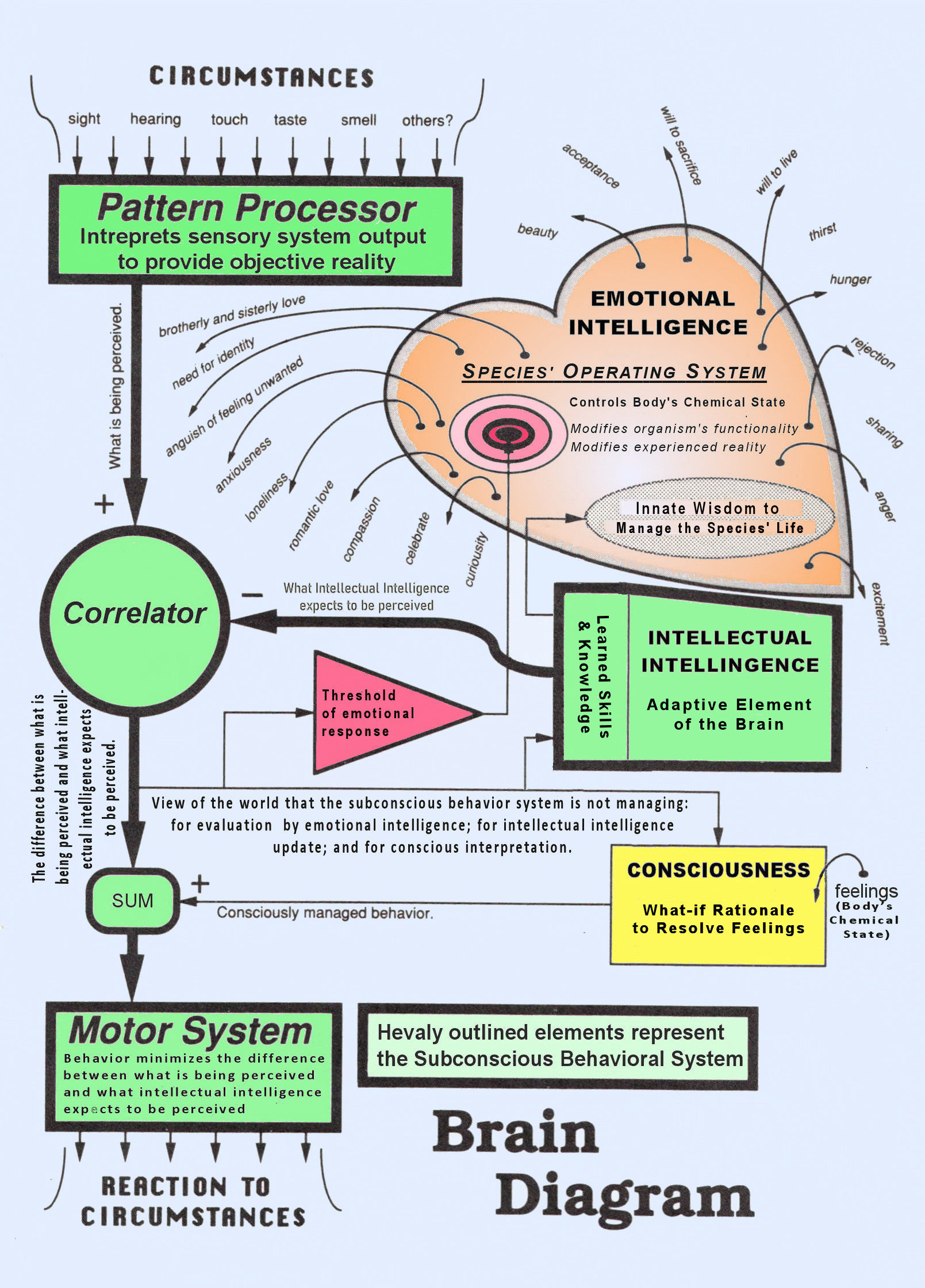
domains. The first is objective reality, supplied by the senses and by what intellectual intelligence has learned, regarding the features of the habitat. The second domain is subjective reality, supplied by emotional intelligence, which reveals the species’ needs through feelings. Together, they shape a living organism’s understanding of the world and its motivation to act within it.
Regarding survival, emotional intelligence provides the will to live—the capacity to value one’s own existence, while intellectual intelligence enables the recognition of threats that endanger one’s existence. Both are essential to survival: Without the ability to value one’s own existence, there would be no reason to avoid danger. Without objective reality, there would be no way to detect danger.
In short, for consciousness to exist, both objective and subjective realities are required. Subjective reality not only imbues consciousness with the will to live, but it also tells consciousness what to do: Do what you feel is the right thing to do, and, conversely, don’t do what you feel is wrong. Otherwise, you won’t be able to live with yourself.
Built-In Rewards and Punishment
There is a reason why spiritually free people do not reward one another with trophies or punish each other with imprisonment: All the rewards and punishments required to maintain the social order that sustains our species’ life are built in. They occur instantly and are thus unavoidable—contentment for doing what feels right and guilt for doing what feels wrong.
Guilt, I believe, can be as severe a punishment for a spiritually free person as prison is for a civilized one. If the prisoner is fortunate, his sentence has a termination date. Guilt, on the other hand, can burden someone for life. Except in cases of behavioral disfigurements, I suspect that spiritually free cultures—in which no legal obligations must be satisfied, and no long-term promises must be kept—rarely experience behavioral problems. Who, in their right mind, would do anything that might burden them with a lifetime of guilt?
I learned that lesson early in life. I was three or four when my brother and I received identical Christmas presents—little toy rabbits, which, when you pushed the tail down, went scooting across the floor. I broke mine by improperly rewinding it. So, in secret, I broke my brother’s, by doing the same thing. I remember that, all these years later, as clearly as if it happened yesterday. I still ask myself: What on Earth possessed me to do something like that? I don’t dwell on it. I didn’t harm or kill anyone. My brother doesn’t even remember the incident.
The Soul’s Restraints
But the point is clear: Even when external restraints are absent, the soul has its own. And I suspect those soul-felt restraints are significantly more powerful than any imposed by institutions. People don’t go around wantonly killing people because, by instinct, we know that we would suffer from guilt if we did.
If someone becomes so emotionally provoked that the arousal overrides their inner restraints, I doubt that legal restraints will stop them, either. That’s a truth that institutions quietly fear—that the real architecture of morality lies within, and it does not answer to prescribed law. After making the above remarks, in discussion groups, I’ve sometimes suggested that, if all laws against murder were struck from the books, the murder rate would hardly change. And—much to my surprise—nearly everyone always seems to agree.
Destiny and Control
If inborn emotional restraints maintain social order, why have humans replaced them with externally imposed systems of punishment? Once humans acquired the spoken word and, with it, the ability to imagine future circumstances, we became obsessed with controlling our destinies. Internal restraints exist to sustain life, not to control the future. Controlling the future requires artificial restraints, which in turn require governmental intervention.
Two problems undermine mankind’s attempt to control the indefinite future. First, the future is inherently unknowable. No matter how elaborate our systems of governance are, or how strictly they control us, they cannot guarantee future outcomes. Second, external restraints apply equally to every individual in a mass culture. By treating subjects as blank slates, governmental interventions displace both internal restraints and internal rewards, leading to immediate spiritual repression, from which we emotionally suffer, and eventually social chaos, from which we materially suffer.
Emotionally Conditioned for Interdependence
To explain the connection between mankind’s effort to control our destiny and our unnatural state of suffering, we again turn to the brain diagram. The input to the gray area, within emotional intelligence—which is labeled, “Innate Wisdom to manage the species’ life”— is pre-processed by the knowledge that intellectual intelligence has learned from personal experience (follow the arrows). This preprocessing is essential because, to satisfy feelings, such as hunger, thirst, or fear, the brain must know where food, water, and safety are located. For most of mankind’s evolution, the safest place to be was within a group whose members depended on one another to survive. Thus, every social primate’s awareness that groups provide the safest environment is not mere knowledge. Because it applies to all social primate cultures, it is also grounded in instinct. As a result, most of the feelings emanating from emotional intelligence in the brain diagram exist to reward people with contentment, for serving our species, within the context of interdependent relationships.
The Fossil Record of Belonging
Because emotional intelligence equates safety with interdependent living, there is no evidence in the fossil record that, before humans institutionally subjugated themselves, they ever survived by living alone or as mating couples. Since then, we have lived almost exclusively either alone or as couples, and have therefore sought safety in institutions and personal wealth. Our new way of life provides remarkable material advantages. But, because institutions will not tolerate interdependent living, we are without natural homes, where—by surviving interdependently—we would feel safe, whether we were or not. Consequently, we are burdened with loneliness, anxiety, and, with no sisters or brothers to take care of, a profound sense of meaninglessness. Yet, we remain blind to the cause of our suffering.
This blindness raises a question: With all the knowledge we have accumulated, and all the research facilities we possess, how can we remain so blind to why we are suffering, when, in view of the above observation, the answer seems obvious?
To further address the question of why we suffer, we again refer to the brain diagram. In a specific habitat, an individual learns, from experience, what must be done to survive. Because this awareness applies to the habitat, it is categorized, in the diagram, as knowledge. If the knowledge of what is required to survive aligns with an individual’s emotional intelligence, then, in the process of surviving, the individual will serve the needs of the species. For that service, the human spirit rewards the individual with a deep sense of purpose, contentment, and belonging. In this way, evolution makes the experience of being alive a win-win-win proposition: First, we survive. By doing so, we contribute to our species’ survival by serving others’ needs. And finally, emotional intelligence rewards us, for our service, with peace of mind.
Institutional Subjugation and Human Suffering
Contrast the spiritually free way of life, described above, with an institutionally subjugated one: Modern human relationships are not grounded in the desire to “be there,” for one another, to fulfill each other’s real and present needs. Modern human relationships are based on legally imposed promises that we struggle to keep, in the belief that, if everyone complies, we will reach the promised land. Instead of experiencing the sense of well-being that comes from mutual trust, we live in a state of shame, interpreting our suffering as evidence of unworthiness before God. Yet, even in suffering, wisdom emerges if we learn to interpret it. Keep in mind what Jesus said: “Blessed are those who are poor in spirit, for theirs is the kingdom of heaven.” In other words, those whose souls recognize that something is tragically wrong will be the ones who enlighten the way to our real homes as we begin awakening to the needs of each other’s souls.
Feelings as the Basis of Reality
This explains why we suffer, but not why our brains are blind to its cause. From the conscious mind’s perspective, feelings are the basis for all values. We think of objective and subjective reality as separate entities, which they are. But, without feelings to infuse the objective world with values, the objective world would not exist—not for us. To illustrate: Suppose we had no emotional intelligence, thus we could not experience any feeling at all. If a tiger emerged from the undergrowth, a few yards away, unable to experience the phenomenon of fear, we could place no negative value on the animal’s presence. And, without the will to live or the ability to experience pleasure of any kind, we could place no positive value on our own existence. We would not react to the tiger’s appearance—not because we were unable, but because, without feelings to satisfy, we would have no reason to react. We view thinking and feeling as separate processes. They are quite different, of course, but we fail to realize that, without feelings that need satisfying, there would be nothing to think about. In other words, from an objective point of view, an individual might be a perfect living specimen. But if the individual were without emotional intelligence, there would be no one home.
To grasp the depth of mankind’s problem, consider the fact that, when our kind began social contracting, the centralized systems of governance on which we have since depended, for survival, have been treating us, largely, as if there is no one home—except, of course, for our fear of what might happen to us, both socially and materially, if we did not comply with institutionally ordained law. To resolve that fear, we have no choice other than to repress most of our other feelings. Consequently, we not only suffer but, for the most part, exist in a state of mindlessness.
If I had developed the diagram to explain the functioning of the civilized mind, the arrow indicating our will to live would dominate the scene. The other arrows—which indicate the feelings through which our emotional intelligence rewards us for serving life would be diminished, most of them to the point of nonexistence. Being forced to seek safety in legally imposed promises and personal wealth, our spirits are not free to take care of life, and we suffer unnaturally. I say unnaturally because life is not ideal. There is suffering to bear even when spiritually free. The difference is that, when suffering belongs to a larger living order, it has meaning. It becomes bearable.
Confirmation Bias and the Promised Land
Having established how significant feelings are to the reality that an animate being experiences, we can now address the reason why the human brain is blind to the cause of our suffering. When we make, and accept, legally imposed promises, in the belief that compliance will lead to the promised land, our minds place positive value on—thus, perceive as real—something that does not exist: The promised land. To comply with our promises, in pursuit of the illusion that the promised land is real, we must deny the feelings that would otherwise lead us to participate in life’s process. Denied the freedom to enjoy life’s process, our minds cannot place value on it; thus, for us, it doesn’t exist. The idea that we suffer because we are failing to serve life’s process, which doesn’t exist—not in our minds—is incomprehensible, so much so that our minds will not register it. When our subconscious minds fail to register an idea, then our conscious minds are denied the opportunity to consider it. That is why we are blind to why we suffer.
Closing Parallel
The history of civil cultures shows how confirmation bias—the brain’s inability to register ideas that contradict what it already believes—blinds societies to simple observations. Galileo’s demonstration that the sun, not the earth, lies at the center of the solar system offered a solution far simpler and more accurate than the elaborate models that preceded it. Yet, his discovery was fiercely resisted, not because the evidence was weak, but because it threatened the authority of scripture and the legal systems built upon it. Fear of civil disorder kept intelligent minds closed to what was obvious.
The same blindness, now, prevents us from recognizing that emotional intelligence exists. Life flourishes on this planet because, among countless other things, animate beings survive by following the simplest instruction imaginable—an instruction that exists only in the subjective domain, thus can be delivered and understood exclusively by emotional intelligence: Do what feels good, and don’t do what hurts. Yet, confirmation bias prevents our minds from registering this proposition, not because it is complicated, lacks evidence, or fails to make sense. Its simplicity is clear, once we stop looking past it. It is because the only comfort we presently experience is the freedom to pursue personal ambitions, in hopes of realizing the future our beliefs promise. To us, that future, and the effort we invest in reaching it, is our reality—the reality that gets us out of bed each morning. Given our dependence on that reality, for survival, and for something to do, each day, our minds can hardly be expected to value the idea that contentment arises from serving life, by honoring innate feelings—the very feelings that civilization, in its eternal pursuit of “truth,” has recast, as the source of evil.
Previous cultures eventually overcame their blindness to how the solar system worked. Perhaps the day will come when we recognize why we suffer unnaturally. That will not eliminate our suffering, but if we are ever to heal emotionally, recognizing why we suffer so is surely the first step.